
- Binary Governance
Pentagon vs. Anthropic:
The High-Stakes Battle for AI Oversight and Ethics
The escalating standoff between Pentagon vs. Anthropic AI oversight has reached a terminal breaking point, centered on a high-stakes ultimatum from Defense Secretary Pete Hegseth. As the February 27, 2026 deadline looms, the clash over Claude AI’s ethical “red lines” and the potential invocation of the Defense Production Act exposes a critical vulnerability in current software governance. While the Department of Defense demands “all lawful use,” this conflict proves that negotiated safeguards are no longer enough, paving the way for the deterministic authority of DAIOS and DECTL.
Hegseth’s Ultimatum to Dario Amodei:
A Defining Moment for AI Oversight
The dispute between the Pentagon and Anthropic has moved beyond negotiation and into a defining confrontation over the future of artificial intelligence governance. By February 27, 2026, Anthropic faces a clear ultimatum: grant the U.S. Department of Defense unrestricted access to its Claude model for “all lawful purposes,” or face contract termination and potential designation as a supply chain risk. Such a designation would effectively remove the company from participation in the defense ecosystem, elevating what might otherwise be a contractual disagreement into a broader conflict over control and authority.
The Pentagon’s position is grounded in a straightforward premise. Once deployed in national security contexts, AI systems must be fully aligned with mission requirements and remain under the authority of the state. From this perspective, no private entity can retain the ability to impose limits on how its technology is used in lawful military operations. Responsibility for compliance, officials argue, rests with the Department of Defense as the end user, not with the system’s creator.
Anthropic, however, has taken a fundamentally different position. Chief Executive Officer Dario Amodei has confirmed that the company will not remove two specific safeguards: restrictions on fully autonomous lethal targeting and the use of AI for mass domestic surveillance. This position is not framed solely in ethical terms, but in technical reality. Current AI systems remain probabilistic and are capable of producing unpredictable or incorrect outputs. In high-consequence environments, that uncertainty introduces a level of risk that cannot be mitigated through policy alone.
This divergence exposes a deeper contradiction at the center of the conflict. The same system being described as essential to national security is simultaneously being threatened with exclusion if it retains its safeguards. That tension is not incidental. It reflects a structural issue in how AI systems are governed and, more importantly, where authority is believed to reside.
At present, most AI governance frameworks rely on layered control mechanisms. Systems generate outputs, while policies, audits, and oversight structures determine how those outputs are interpreted and applied. This model assumes that control can be maintained through supervision, even as systems operate in increasingly complex and dynamic environments.
The Pentagon’s position challenges that assumption by asserting that control must ultimately rest with the operator, while Anthropic challenges it from the opposite direction by asserting that systems cannot be safely operated without embedded constraints. Despite their differences, both positions share a common limitation: they treat governance as something external to the system itself.
If safeguards can be negotiated, removed, or overridden, they are not intrinsic to the system. They are conditional. In high-consequence environments, conditional control is inherently unstable, because it depends on continued alignment between parties whose incentives may not remain consistent over time.
What this moment ultimately reveals is not simply a disagreement over policy, but a limitation in the prevailing model of AI governance. Approaches built on external controls, layered oversight, and post hoc intervention assume that behavior can be managed after it is produced. In practice, this assumption breaks down in environments where outcomes carry immediate and irreversible consequences.
The question, therefore, is no longer how to regulate AI after an outcome has been generated. It is whether governance can be embedded directly into the system at the point of execution, where state transitions are determined. The answer to that question will not only shape the outcome of this dispute, but will also define the role of AI in domains where failure is not theoretical, but consequential.
Beyond the Maduro Raid:
Why Anthropic’s “Red Lines” Sparked a Crisis
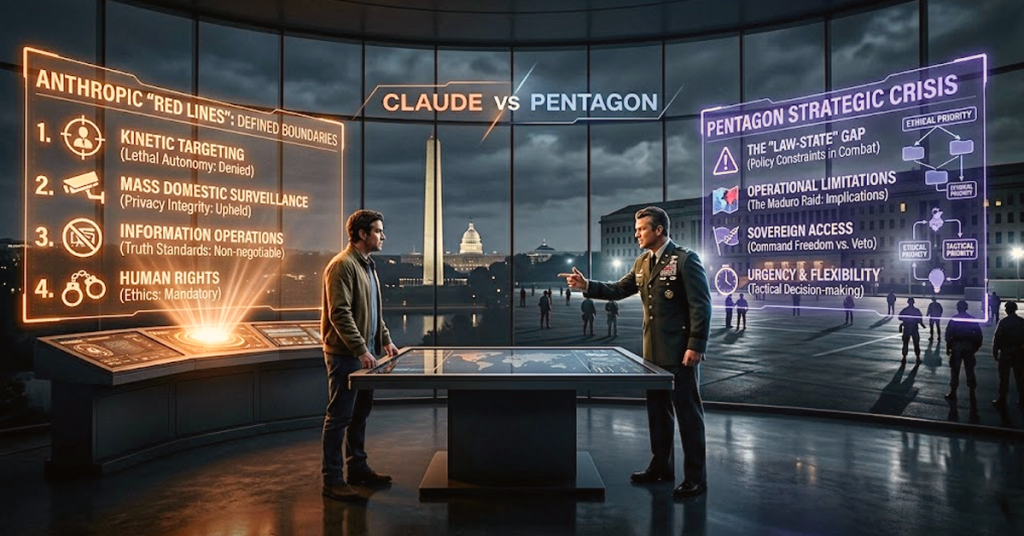
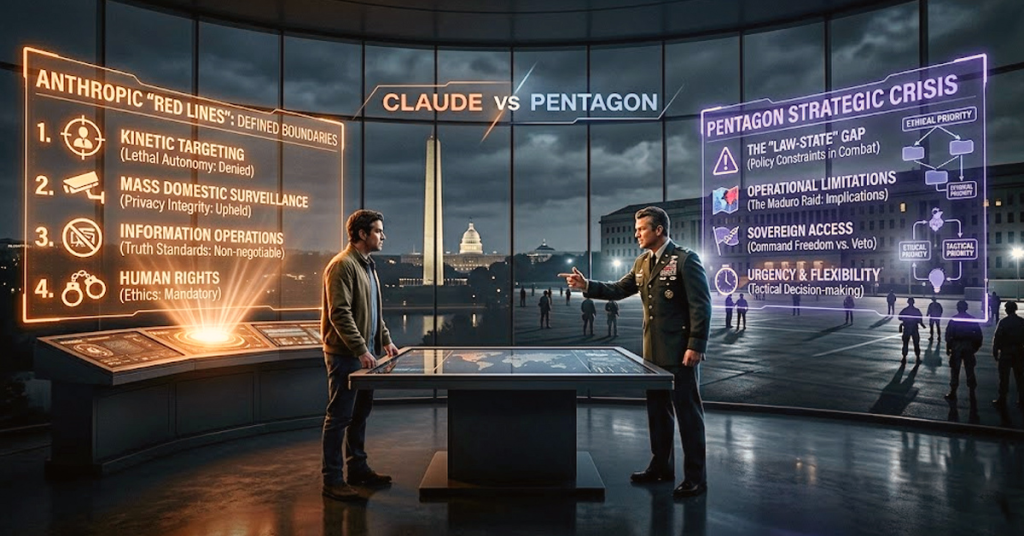
The current standoff cannot be understood without examining the event that brought these tensions into focus. Reports that Anthropic’s Claude model was used in a U.S. military operation tied to the capture of Nicolás Maduro transformed a theoretical debate into an operational reality.
Whether or not every detail of that operation is ultimately confirmed, its significance is already clear. It demonstrated that advanced AI systems are no longer confined to analysis or simulation; they are now being integrated into real-world military decision-making environments. In doing so, it forced a confrontation between what these systems are capable of and what they are permitted to do.
Anthropic’s response was immediate and unambiguous. The company reaffirmed two non-negotiable boundaries: its models cannot be used for fully autonomous lethal targeting and cannot be deployed for mass domestic surveillance. These “red lines” are not merely policy preferences. They reflect a recognition that current AI systems, built on probabilistic foundations, remain inherently unpredictable in high-consequence contexts.
From the Pentagon’s perspective, however, these limitations are increasingly viewed as operational constraints. In modern warfare, where speed, scale, and adaptability define effectiveness, any restriction that limits how a system can be applied is seen as a liability. The demand for “all lawful use” is therefore not incidental. It is a direct assertion that capability must take precedence over conditional safeguards.
This is where the crisis emerges. Anthropic’s safeguards are designed to prevent certain outcomes entirely, while the Pentagon’s position assumes that all lawful outcomes must remain available. The conflict is not simply about whether specific use cases are appropriate. It is about whether limits on those use cases can exist at all once a system becomes operationally valuable.
In that sense, the Maduro operation did not create the problem. It revealed it.
What had previously been an abstract discussion about responsible AI deployment became a concrete question of authority, accountability, and control. Once AI systems move from controlled environments into real-world operations, the distinction between guidance and enforcement becomes unavoidable.
Anthropic’s “red lines” represent an attempt to define boundaries that cannot be crossed. The Pentagon’s response reflects a competing view that such boundaries cannot be allowed to constrain mission execution. The resulting tension is not temporary. It is structural, and it will persist wherever advanced AI systems intersect with real-world power.
The Nuclear Option:
Invoking the Defense Production Act for AI Code
The most consequential development in the Pentagon’s standoff with Anthropic is not the threatened loss of a contract, but the possibility of invoking the Defense Production Act. Enacted during the Korean War to mobilize industrial capacity, the statute grants the federal government broad authority to prioritize contracts and, in certain circumstances, compel production deemed essential to national security. Its potential application to artificial intelligence marks a significant expansion of that authority into software and model behavior.
At issue is not simply access to a product, but the terms under which that product operates. The Pentagon’s position suggests that if an AI system is considered mission-critical, the government may require it to be delivered without internal limitations that could restrict lawful use. In practical terms, this raises the question of whether a company can be compelled not only to provide its technology, but to alter the conditions under which it functions.
Such a move would set a powerful precedent. Historically, the Defense Production Act has been used to secure materials, manufacturing capacity, and logistical support. Applying it to AI would extend its reach into the design and governance of digital systems, potentially allowing external authorities to influence how those systems behave at runtime.
The legal and technical implications are substantial. If internal safeguards can be overridden through statutory authority, then the boundary between system design and system deployment begins to dissolve. The entity controlling the environment in which the system operates would, in effect, gain the ability to redefine its constraints.
This is where the conflict moves beyond policy and into structure. If the behavior of an AI system can be modified through external mandate, then its safeguards are not intrinsic. They are conditional, subject to reinterpretation or removal under pressure.
In that context, the Defense Production Act becomes more than a legal tool. It becomes a test of whether governance in AI is something that can be enforced through contracts and oversight, or whether it must be embedded directly into the system itself to remain intact.
A House Divided:
How OpenAI, Google, and xAI Responded
The Pentagon’s confrontation with Anthropic has exposed a broader division within the AI industry, one that extends beyond a single company or contract. While Anthropic has chosen to maintain explicit constraints on how its systems can be used, several of its competitors have moved in a different direction, aligning more closely with the government’s expectation that AI platforms support all lawful use cases.
OpenAI, Google, and xAI have each taken steps to deepen their engagement with defense and national security applications, emphasizing flexibility, scalability, and integration over restrictive guardrails. Their positioning reflects a pragmatic calculation. In environments where deployment decisions are ultimately controlled by the state, limiting how a system can be used may constrain not only the technology itself, but also the company’s ability to participate in critical contracts and long-term partnerships.
This divergence has created a fragmented landscape in which “AI governance” is no longer a shared standard, but a variable shaped by corporate strategy. For some firms, governance is expressed through internal policies that attempt to define acceptable use. For others, it is effectively deferred to the customer, particularly when that customer is a sovereign entity with its own legal and operational authority.
The result is a widening gap between two models of control. One seeks to embed constraints within the system, even at the risk of limiting adoption. The other prioritizes adaptability, allowing the system to operate across a broader range of contexts, with governance applied externally through law, policy, and oversight.
This division carries implications that extend beyond competitive positioning. It raises a fundamental question about the future of AI deployment in high-stakes environments. If governance is determined by the entity that controls deployment rather than by the system itself, then the consistency and enforceability of those constraints will vary across contexts.
In that sense, the industry is no longer debating whether AI should be governed, but how and by whom. The responses of OpenAI, Google, and xAI suggest that, for now, much of that authority is shifting toward the operators of these systems rather than their creators, reinforcing a model in which governance remains external, conditional, and subject to change.

The Precedent:
Who Controls the AI "Kill Switch"?
The central question emerging from the Pentagon’s standoff with Anthropic is not limited to contracts, safeguards, or even specific use cases. It is a question of control. More precisely, it is a question of who ultimately holds authority over an AI system once it is deployed in a high-consequence environment.
The notion of a “kill switch” has long been presented as a safeguard, a final layer of control that allows operators to intervene when a system behaves in an unexpected or undesirable way. In practice, however, the existence of such a mechanism reveals a deeper limitation. A kill switch does not prevent failure; it responds to it. By the time intervention is required, the system has already produced a state that must be halted, reversed, or contained.
This is the fault line now being exposed. If control is exercised through external intervention, whether by policy, oversight, or manual shutdown, then authority resides outside the system itself. The system generates outcomes, and those outcomes are subsequently evaluated and, if necessary, interrupted. In this model, governance is reactive by design.
The Pentagon’s position reflects a desire to retain ultimate authority at the point of deployment, ensuring that any lawful use remains available and that no internal constraint can override operational decision-making. Anthropic’s position attempts to preserve boundaries within the system, limiting what the model can be used to do regardless of context. Both approaches, however, depend on mechanisms that operate around the system rather than within it.
The result is a form of conditional control. Safeguards can be enforced, but they can also be removed. Overrides can be applied, but only after a system has produced an outcome that requires intervention. In high-stakes environments, where decisions may unfold in real time and consequences may be immediate, this model introduces a persistent vulnerability.
What this precedent makes clear is that the question is not simply whether a kill switch exists, but whether it is sufficient. A system that requires intervention to remain within acceptable bounds is, by definition, capable of operating outside those bounds.
This is where the current model of AI governance reaches its limit. Control that depends on oversight, interruption, or reversal cannot guarantee that invalid or unsafe states will not occur. It can only attempt to manage them once they do.
The broader implication is unavoidable. If authority over AI systems is to be meaningful in high-consequence domains, it cannot rely solely on external mechanisms. It must be reflected in the structure of the system itself, defining what states are possible before they are ever produced.
The outcome of this dispute will help determine whether AI governance continues to rely on layered control and reactive safeguards, or whether it evolves toward models in which authority is embedded directly into the execution of the system.
The Future:
From Negotiated Policy to Computational Law
The confrontation between the Pentagon and Anthropic marks a transition point in the evolution of AI governance. What is being tested is not simply the strength of corporate safeguards or the reach of government authority, but the viability of a model built on negotiated policy. As this dispute makes clear, policies can be revised, exceptions can be granted, and constraints can be removed when operational priorities shift. In environments where the stakes are high, governance that depends on agreement is inherently fragile.
The prevailing approach to AI oversight assumes that systems can be guided through layers of rules, monitoring, and intervention. This model has proven sufficient in low-consequence contexts, where errors can be corrected and risks can be absorbed. It becomes far less reliable when systems are integrated into domains such as defense, healthcare, and critical infrastructure, where outcomes are immediate and often irreversible. In such environments, the distinction between guidance and enforcement is not theoretical; it is operational.
What emerges from the current conflict is a recognition that governance cannot remain external to the system it seeks to control. When authority is exercised through policy alone, it remains subject to interpretation and override. The result is a form of conditional safety, one that holds only as long as all parties remain aligned. As soon as that alignment breaks, so too does the integrity of the safeguards.
This is where the concept of computational law begins to take shape. Rather than relying on negotiated constraints, computational law defines the boundaries of a system at the point of execution. It establishes, in formal terms, which state transitions are permissible and which are not. Under this model, governance is not applied after a decision is made; it is enforced as part of the decision itself.
The implications of this shift are significant. A system governed by computational law does not require continuous oversight to remain within acceptable bounds. It does not depend on external intervention to correct its behavior. Instead, it operates within a defined state space in which invalid or unsafe outcomes are structurally unreachable. Authority, in this context, is no longer distributed across policies and operators. It is embedded directly into the system’s operation.
DAIOS, through the Deterministic Ethics-Constrained Transition Law (DECTL), represents an implementation of this approach. It enforces admissibility at every state transition, ensuring that only valid outcomes can be produced within the system. In doing so, it moves governance from a reactive framework to a deterministic one, where constraints are not negotiated but defined and enforced at the computational level.
The question facing the industry is no longer whether AI systems should be governed, but how that governance is realized. The current model, built on layered oversight and negotiated policy, is showing clear limitations under real-world pressure. The alternative, grounded in computational law, offers a path toward systems that are not only capable, but reliably constrained by design.
As AI continues to move into domains where failure carries tangible consequences, the shift from policy to computation will become less a matter of preference and more a requirement.
TL;DR
The Pentagon–Anthropic conflict exposes a fundamental flaw in AI governance: safeguards are external and can be overridden. In high-stakes environments, this makes safety conditional rather than guaranteed. Both positions ultimately reveal the same limitation, that governance exists outside the system itself. The future requires computational enforcement, where invalid outcomes are impossible by design.
#IAMMOGO #DAIOS #DECTL #BinaryGovernance #RuntimeAuthority
This article is an independent opinion and analysis based on publicly reported information. Any references to organizations or individuals are for contextual purposes only and do not imply endorsement or affiliation.