
- Binary Governance, Deterministic Computing
The Future of Real-Time Sync:
Why Deterministic State Distribution is Disrupting Edge Computing
Modern real-time systems are fast, but they are not consistent. Devices process events at different times, interpret instructions differently, and inevitably drift out of sync. . This architectural flaw creates a ripple effect of instability, significant replay overhead, and unreliable system behavior.
The fundamental problem lies not in the speed of execution, but in the underlying structure of the architecture.
Traditional event-driven systems depend on interpretation. Each device is forced to reconstruct an outcome from a sequence of instructions, making execution highly sensitive to timing, ordering, and local conditions. This is why digital drift and synchronization failures persist in distributed networks.
Deterministic State Distribution removes this dependency
Instead of sending a list of instructions, this model distributes a single, authoritative state. Every device on the network receives the same defined outcome and executes it directly. Execution does not require interpretation, historical replay, or deviation from the defined state.
This shift moves real-time systems away from probabilistic inference and toward deterministic execution through state distribution. As edge computing scales to thousands of devices, consistency becomes more critical than raw performance. This model ensures that synchronization is no longer something you manage, it is something you guarantee.
Deterministic State Distribution:
Defining the Model
Deterministic State Distribution shifts the paradigm from instruction-based communication to outcome-based coordination. While conventional systems rely on devices to receive, interpret, and execute sequences of commands over time, this model distributes a complete and authoritative definition of the system state at a specific execution point.
Each state is self-contained and versioned, allowing all connected devices to receive the same state and apply it without modification. Consequently, execution does not depend on prior events, message order, or local interpretation.
The model is defined by three characteristics:
– Central Authority: A single authoritative source defines all system behavior.
– Stateless Operation: Execution nodes operate without persistent state or interpretive logic.
– Uniform Enforcement: System outcomes are determined centrally and enforced uniformly across all devices.
Within this architecture, devices function as stateless endpoints that render the current state defined by the controller rather than reconstructing behavior from instructions or maintaining historical context. This approach eliminates execution ambiguity and ensures consistent system behavior across all nodes.
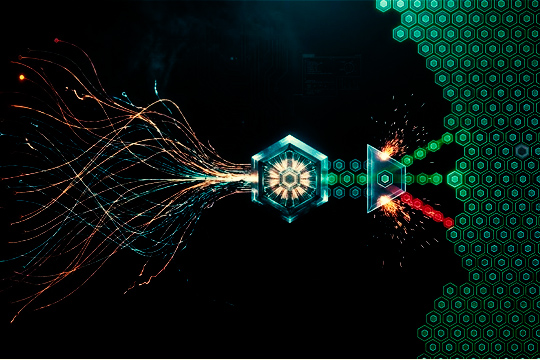
Eliminating Synchronization Backlogs and Replay Latency
In event-driven systems, correctness depends on the successful processing of every intermediate step. When events are delayed, lost, or processed out of sequence, devices must reconstruct system state by replaying prior instructions. This requirement introduces synchronization backlogs, increases latency, and creates additional failure points, particularly in distributed environments with variable network conditions.
Deterministic State Distribution removes this dependency by defining system behavior through state rather than sequence. Each state update represents the complete system outcome at a given execution point. Devices do not require historical context to determine current behavior, as the latest valid state fully defines the system condition.
Upon receiving the most recent state, a device applies it directly and aligns with the authoritative system definition. Devices may join, disconnect, or reconnect without requiring replay or synchronization processes, as no intermediate steps are required for correct execution. Network variability may affect the timing of state delivery; however, it does not affect execution correctness.
Key Operational Advantages:
Zero-Context Resumption: A node can “wake up” at any time and become immediately current by applying the latest broadcast. There is no need to query a database for what it missed.
Atomic State Transitions: Because the state is self-contained, there is no “partial” success. The device either transitions to the new state $(\text{State}_{n})$ or remains in the previous one $(\text{State}_{n-1})$ until the next update arrives.
Drift Immunity: By eliminating dependence on event history and sequence reconstruction, the system prevents the accumulation of drift and removes the need for corrective synchronization mechanisms.
By shifting the burden of logic from the endpoint to the authoritative state, the architecture ensures that the entire network functions as a single, cohesive entity regardless of individual node lifecycle or network jitter.
Governance at the Edge with DAIOS and DECTL
Consistency without enforcement does not guarantee system integrity, as a system that executes consistently but admits invalid or unsafe states remains vulnerable to failure. Execution must therefore be governed at the point where state transitions are realized.
Deterministic State Distribution enforces this requirement at the execution boundary through two integrated components:
DAIOS (Deterministic AI Operating System): The system functions as the absolute execution authority, evaluating each incoming state prior to execution to apply a binary decision: the state is either permitted or rejected. No partial execution is allowed, and no interpretation occurs beyond this boundary. A state that passes this gate is executed exactly as defined, while a state that fails is not executed under any condition.
DECTL (Deterministic Ethics-Constrained Transition Law): The rule system defines the criteria that govern admissibility by establishing structural validity, enforcing sequencing constraints, and defining the operational boundaries within which the system must operate. State transitions that do not satisfy these conditions are classified as invalid and are rejected before they can influence system behavior.
Together, these components form a closed-loop execution model in which definition, validation, and execution are inseparable. State is defined centrally, validated against deterministic constraints, and executed only if it satisfies all admissibility criteria. Invalid states do not propagate, do not degrade system behavior, and do not require correction after the fact.
This model does not attempt to detect or recover from failure conditions during execution. It prevents those conditions from being realized in the first place.

Use Case Examples:
From Immersive Venues to Industrial IoT
Deterministic State Distribution is applicable in environments where multiple devices must produce a consistent, unified outcome without tolerance for divergence.
In live immersive environments, coordinated systems such as lighting, media, and control infrastructure are required to operate in precise alignment. Variations in timing or execution across devices result in visible inconsistencies that degrade the experience. Deterministic State Distribution ensures that all devices execute the same state, eliminating misalignment caused by latency or sequencing differences.
In distributed device orchestration, organizations manage heterogeneous hardware across local or edge networks. Traditional approaches introduce complexity through synchronization logic, event replay, and cloud dependency. Deterministic State Distribution removes these requirements by enforcing a single authoritative state, allowing diverse devices to operate consistently without maintaining shared execution history.
In human-interactive systems, users interact with shared digital or physical environments that demand immediate and consistent feedback. Differences in execution across devices undermine usability and reduce system trust. Deterministic State Distribution ensures that all participants experience the same authoritative state at the same execution point, regardless of their individual device hardware or connection lifecycle.
Implementation Verticals:
Theme Parks & Attractions: Synchronizing thousands of distributed lighting fixtures, spatial audio nodes, and animatronics to a single heartbeat without “cue drift” or sequencing lag.
Casino Floor Management: Real-time synchronization of thousands of gaming terminals to ensure payout transparency, game-state integrity, and unified visual messaging across the entire floor.
Smart Manufacturing & Robotics: Coordinating heterogeneous robotic arms and conveyor systems where every component operates from a shared spatial state, preventing collisions caused by local processing delays.
Digital Signage & Large-Scale Arrays: Driving high-density LED walls or distributed screen networks as a single unified canvas, where every pixel-node is locked to the same authoritative frame.
Mission-Critical IoT: Managing distributed sensor and actuator networks in power grids or water treatment facilities where every endpoint must reflect the current “safe state” of the physical system instantly upon reconnection.
Shared Augmented Reality (AR): Enabling multiple users to interact with the same digital objects in the same physical space with zero divergence in how those objects behave or move between devices.
Smart Hotels & Hospitality: Orchestrating room controls, guest services, and interactive signage across thousands of endpoints. Local execution ensures that lighting, climate, and security systems remain responsive even if external internet fails.
Airports & Transit Hubs: Managing real-time data distributions for flight info, security, and baggage systems. Moving logic to the edge eliminates the “probabilistic” lag of cloud-based updates.
Campus & Educational Facilities: Coordinating security lockdowns and synchronized instructional media across multiple buildings. Deterministic state ensures protocols are enforced uniformly and instantly across the local network.
Government & Secure Municipal Buildings: Providing sovereign, local infrastructure for facility management. Removing cloud dependency allows a proactive, reactive environment that scales while maintaining absolute “Binary Custody” over operational data.

Engineering Absolute Certainty
Traditional distributed systems are built on eventual consistency, a model that tolerates transient inconsistency with the expectation that alignment will occur over time. In real-time environments, where execution must be correct at the moment it occurs, this assumption introduces unacceptable risk.
Deterministic State Distribution replaces eventual consistency with immediate alignment. By centralizing authority, removing interpretive execution, and enforcing admissibility at the execution boundary, the system ensures that all nodes converge to a single, consistent state at the point of execution rather than at a later, undefined point in time.
This model eliminates reliance on reconciliation, replay, and corrective synchronization. System behavior is no longer influenced by timing variation, message ordering, or device-specific conditions. Instead, execution is governed by a single authoritative definition that is applied uniformly across all nodes.
The result is a system in which correctness is inherent to the architecture. Variability in network conditions does not produce divergence, and failure modes associated with event sequencing are removed rather than managed.
Deterministic State Distribution therefore represents a structural shift in system design. It establishes a framework in which system behavior is defined once, validated before execution, and enforced consistently across all participating devices, providing a foundation for real-time coordination where certainty is required.

TL;DR
“Do not synchronize the system. Define it once and enforce it everywhere.”
Deterministic State Distribution replaces event-driven execution with a single authoritative state that every device applies uniformly. By eliminating interpretation, replay, and timing dependency, it ensures immediate consistency across distributed systems. The result is a real-time architecture where synchronization is guaranteed by design rather than maintained through correction.
#IAMMOGO #DAIOS #DECTL #SYNKTRON #TRUESTATE #ZEROLEAK
This article is an independent opinion and analysis based on publicly reported information. Any references to organizations or individuals are for contextual purposes only and do not imply endorsement or affiliation.