
AI lawsuits are no longer a future risk, they are the delayed consequence of a design choice the industry normalized without fully understanding. For years, AI systems have been deployed into insurance approvals, medical decisions, financial assessments, content moderation, and customer disputes with one shared assumption, that confident predictions were good enough. They were not. These systems do not fail loudly. They fail silently, issuing decisions without proof, without traceable reasoning, and without a verifiable path back to how or why an outcome occurred. Courts are now encountering those silent failures not as technical anomalies, but as evidence. When harm occurs and no system can demonstrate how a decision was formed, or whether it should have been allowed at all, liability does not disappear. It concentrates. That is why 2026 is shaping up to be the year AI lawsuits stop being edge cases and start becoming precedent.
WHY AI LAWSUITS ARE NO LONGER HYPOTHETICAL
AI lawsuits are no longer hypothetical because AI systems are no longer experimental, they are operational. They decide who gets approved, who gets denied, who gets flagged, who gets reviewed, who gets escalated, and who gets ignored. In insurance, healthcare, finance, and digital platforms, AI outputs are now functionally equivalent to human decisions, except they are issued faster, at scale, and often without a clear explanation of how they were reached. That shift changes everything. When decisions carry real-world consequences, the legal system does not ask whether an AI was impressive. It asks whether the decision was reasonable, explainable, and defensible.
The problem is not that AI makes mistakes, every system does. The problem is that many modern AI systems cannot prove what they did or why they did it. Probabilistic architectures are optimized to predict likely outcomes, not to preserve a verifiable chain of reasoning. When something goes wrong, there is often no deterministic record showing which inputs mattered, which rules applied, or whether the outcome violated internal or external constraints. From a courtroom perspective, that absence is not a technical limitation. It is a failure of duty. If a system cannot demonstrate how a decision was formed, it cannot demonstrate that the decision should have been allowed to occur.
That is why lawsuits are emerging now. Not because courts suddenly care about AI, but because harm paired with opacity collapses defenses. When organizations deploy systems that act with authority but cannot explain themselves under scrutiny, liability does not hinge on intent or innovation. It hinges on accountability. As more cases surface and patterns repeat, judges and regulators are beginning to treat silent AI failures not as anomalies, but as foreseeable risks. Once that threshold is crossed, lawsuits stop being edge cases and start becoming precedent.
AI LAWSUITS AND THE SILENT-FAILURE PROBLEM BUILT INTO PROBABILISTIC AI
Modern AI systems are not designed to fail loudly. They are designed to produce an answer, even when certainty is low, context is incomplete, or the decision should not be made at all. That behavior is not a flaw in implementation. It is a consequence of probabilistic architecture. These systems optimize for likelihood, not provability, and they are structurally incentivized to return a result rather than halt, defer, or refuse. In high-stakes environments, that design choice becomes dangerous.
Silent failure occurs when an AI system generates an output that appears valid on the surface but cannot be traced back to a verifiable decision path. There is no explicit error, no visible malfunction, and often no internal signal that something went wrong. The system simply proceeds. From an operational standpoint, this feels efficient. From a legal standpoint, it is catastrophic. When harm occurs, organizations are left without the ability to demonstrate how the decision was reached, what constraints were applied, or whether the system should have been allowed to act in the first place.
This is where AI lawsuits take shape. Courts do not evaluate model confidence or statistical performance. They evaluate evidence. If an AI system cannot show which inputs mattered, which rules governed the outcome, or how conflicting signals were resolved, the output becomes indefensible under scrutiny. Silence is no longer neutral. It is interpreted as absence of control. As probabilistic systems continue to operate in domains where errors carry legal and human consequences, silent failure is increasingly being treated not as an accident, but as a foreseeable architectural risk.
WHEN AI DECISIONS CAN’T BE PROVEN,
LIABILITY FOLLOWS
AI decisions are now being tested in court not as abstract theories but as real evidence of harm. In Raine v. OpenAI, parents have filed federal wrongful death claims against OpenAI, alleging that their son’s interactions with a chatbot contributed to his suicide, and that safety protocols were insufficient and untraceable in how they responded to crisis cues. This case is one of at least eight wrongful death suits over harmful chatbot guidance and illustrates how courts confront decisions when the system itself cannot show the reasoning behind those outputs.
In healthcare, plaintiffs have successfully moved forward with a class action against UnitedHealth Group and its algorithm-driven care denial system, alleging that AI tools like nH Predict were used to deny essential Medicare Advantage coverage and override physician determinations. Federal judges have allowed breach of contract and good-faith claims to proceed, spotlighting the legal exposure when coverage decisions cannot be explained or justified.
In another part of the insurance industry, State Farm is facing a federal lawsuit alleging that AI-assisted claims processing discriminated against elderly, disabled, and minority homeowners by subjecting their storm damage claims to heavier scrutiny and delays, leading to financial hardship. The complaint cites multiple anti-discrimination statutes and seeks damages as well as systemic audits of the insurer’s claims processes, challenging how algorithmic decisions can be proven fair and lawful.
AI bias cases are also emerging in employment and platform contexts. Lawsuits against large tech platforms like Meta are testing whether algorithmic systems used in hiring, ad delivery, or content moderation can be shown in court to adhere to anti-bias and privacy norms when plaintiffs claim discrimination or improper use of personal data.
Elsewhere, courts are confronting insurance algorithm challenges beyond UnitedHealth. Similar class actions are targeting Medicare Advantage plans that rely on automated decision models to expedite claim denials, and federal judges are refusing to restrict discovery into how these models reach outcomes, signaling judicial insistence on transparency when human health and welfare are at stake.
Even outside health and insurance, companies like Grok-powered services and generative AI platforms are seeing harassment and negligence claims from users and third parties alleging that AI outputs contributed to harm, abuse, or unsafe outcomes, forcing early litigation over accountability and traceability. Although still developing, these cases highlight a broader shift: when an AI system’s actions cannot be traced with clear evidence of decision logic, courts are increasingly willing to treat algorithmic opacity as a source of liability, not a technicality.
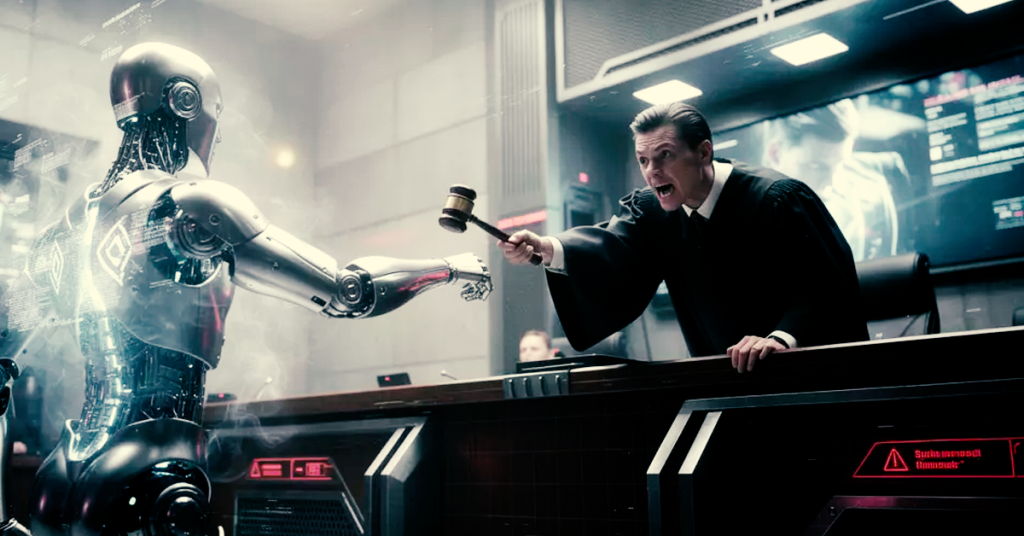
WHY ENTERPRISES DEPLOYING AI
ARE NOW LEGALLY EXPOSED
Enterprises are legally exposed because AI has quietly crossed a threshold of authority. These systems are no longer advisory tools sitting behind human judgment. They are embedded directly into workflows that approve, deny, rank, prioritize, flag, delay, or escalate real outcomes. In insurance, healthcare, finance, hiring, and digital platforms, AI outputs increasingly function as final decisions, even when a human nominally remains in the loop. From a legal standpoint, that distinction matters less than companies assume. If a human consistently defers to the system, the system is exercising authority, and authority carries liability.
The risk compounds at scale. Enterprises deploy AI to move faster, reduce cost, and standardize decisions across millions of interactions. When a flawed or biased decision occurs once, it is an error. When it occurs thousands or millions of times, it becomes a pattern. Courts and regulators do not treat repeated harm as accidental. They treat it as foreseeable. If an organization chose to automate decisions without ensuring provable reasoning, auditability, and constraint enforcement, that choice itself becomes part of the liability analysis.
Another source of exposure is delegation without visibility. Many enterprises rely on third-party AI models, vendor platforms, or opaque internal systems that cannot fully explain how outputs are generated. When harm occurs, contracts do not shield responsibility. Courts look to the party that deployed the system, benefited from it, and allowed it to act. If an enterprise cannot demonstrate how a decision was reached, which safeguards were applied, or why the outcome complied with law and policy, responsibility does not disappear into the supply chain. It returns to the deployer.
Finally, enterprises are exposed because legal standards were never written for probabilistic authority. Traditional compliance assumes that decisions can be reviewed, justified, and corrected. Probabilistic AI often cannot meet that expectation. When systems produce confident outputs without a verifiable decision path, organizations are left unable to meet basic legal duties such as explaining denial of service, defending adverse actions, or demonstrating non-discrimination. As courts increasingly recognize this gap, enterprises that rely on unverifiable AI are finding themselves unable to defend outcomes they can no longer fully explain.
WHY REGULATION AND COMPLIANCE CAN’T FIX BROKEN AI ARCHITECTURE
Regulation is designed to govern behavior, not to repair structural flaws. Most current AI compliance efforts focus on documentation, disclosures, risk assessments, and oversight committees. These measures can improve transparency around how AI is deployed, but they do not change how the system itself makes decisions. If an AI system is architected to produce probabilistic outputs without preserving a verifiable decision path, no amount of policy or reporting can make those decisions provable after the fact.
This gap becomes clear in legal scrutiny. Compliance frameworks often assume that decisions can be reviewed, audited, and explained when challenged. Probabilistic AI systems frequently cannot meet that assumption. They generate outputs based on statistical inference rather than deterministic state transitions, and once an output is produced, there may be no reliable way to reconstruct why it occurred, which inputs mattered, or whether constraints were violated. Regulation can require explanations, but it cannot manufacture evidence that the system was never built to retain.
There is also a dangerous false sense of protection created by compliance checklists. Organizations may believe that meeting regulatory requirements shields them from liability, when in reality courts focus on outcomes and accountability, not procedural box-checking. If harm occurs and the system cannot demonstrate how a decision complied with law or policy, compliance artifacts do not substitute for proof. In many cases, they amplify exposure by showing that risks were known and left unresolved.
Ultimately, regulation can set boundaries for acceptable use, but it cannot transform an architecture that is incapable of restraint. Systems that cannot refuse to act, cannot halt on uncertainty, and cannot prove why a decision was allowed to occur remain legally fragile regardless of how well they are documented. Until AI systems are engineered to enforce constraints at the decision level rather than explained after the fact, regulation and compliance will remain necessary, but insufficient, defenses.
WHY 2026 MAY MARK THE END OF “TRUST ME” AI
For more than a decade, AI adoption has been driven by performance metrics, speed, and scale. If a system appeared accurate enough, confident enough, or efficient enough, it was trusted to act. That era is ending. Courts, regulators, and enterprises are converging on a simpler standard, proof over prediction. It is no longer sufficient for an AI system to say it is likely correct. It must be able to show why a decision was allowed to occur and whether it should have occurred at all.
The shift is not philosophical. It is practical. When AI decisions affect insurance coverage, medical care, financial access, employment, or personal safety, trust without verification becomes indefensible. As lawsuits move forward and precedents form, organizations are discovering that probabilistic confidence does not satisfy legal standards of reasonableness, causation, or accountability. What cannot be proven cannot be defended, and what cannot be defended becomes liability.
2026 represents a tipping point because patterns are becoming visible. Courts are no longer seeing isolated incidents. They are seeing repeatable failure modes tied to how AI systems are built. As that recognition spreads, the burden shifts from individuals harmed by AI decisions to the organizations that deployed them. At that moment, “trust me” AI loses its protective cover. Systems that can prove their decisions will endure. Systems that cannot will be forced to change, or be forced out.
WHY PROOF, NOT PREDICTION,
WILL DECIDE THE FUTURE OF AI
Prediction has always been sufficient when AI was treated as advisory. If a system was wrong, a human could override it, absorb the error, or explain the outcome. That assumption no longer holds. AI systems are now making decisions that affect legal rights, access to care, financial stability, and personal safety. In those domains, prediction is not a substitute for justification. Courts do not evaluate likelihood. They evaluate whether a decision can be proven reasonable, constrained, and lawful.
Proof requires something prediction alone cannot provide. It requires a system to demonstrate how an outcome was reached, which inputs were considered, which rules or constraints applied, and why alternative outcomes were rejected. Probabilistic systems are not designed to preserve that trail. They optimize for accuracy across populations, not defensibility in individual cases. When challenged, they can offer confidence scores or statistical explanations, but not evidence that a specific decision should have been allowed to occur. In legal terms, that gap is decisive.
As AI becomes embedded in governance, commerce, and public life, the standard for acceptable automation is changing. Systems will be judged not by how often they are right, but by whether they can prove correctness when it matters. This is the foundation of computational law and deterministic architecture. Decisions must be bounded by enforceable constraints and recorded in a way that survives scrutiny. The future of AI will belong to systems that can stop, refuse, and explain themselves, not just systems that predict. In a world where AI outcomes are examined under oath, proof is no longer optional. It is the price of participation.

TL;DR
AI was trusted to predict. Courts now demand proof. In 2026, unverifiable AI stops being impressive and starts being indefensible.