
IAMMOGO Intelligence Company is officially reclassifying DAIOS.
The system is no longer categorized as an AI governance tool, as it has now been defined as Execution Enforcement.
The change is intended to clarify where DAIOS operates in the enterprise AI stack. AI governance generally refers to the policies, oversight structures, compliance processes, monitoring systems, audit practices, and risk frameworks used to manage artificial intelligence. Those systems help organizations define expectations and review whether AI deployments are operating within approved boundaries.
DAIOS operates at a different technical boundary.
Rather than functioning as a policy framework or post-execution review tool, DAIOS evaluates proposed system actions before they execute. Its function is not only to document what happened or determine whether an event can be reviewed later. Its function is to determine whether a proposed operation is permitted to become an executed event.
That distinction is the basis of the reclassification.
AI governance defines what should be allowed.
Execution Enforcement determines what is allowed to execute.
Execution Enforcement
The process or system by which a proposed action, command, state change, or operation is evaluated before it is allowed to execute.
In technology:
A control layer that determines whether a system action is authorized, blocked, redirected, conditioned, or held for additional information before the action becomes an operational event.
Example:
DAIOS is classified as Execution Enforcement because it evaluates proposed state transitions before execution, rather than merely monitoring or reporting system behavior after the fact.
Plain meaning:
Governance defines the rules. Execution Enforcement decides whether an action is allowed to happen.
Why Execution Enforcement Is the Correct Category for DAIOS
The enterprise AI market has placed a wide range of technologies under the broad label of AI governance. Policy engines, model monitoring platforms, compliance dashboards, risk scoring systems, audit tools, prompt filters, observability layers, and institutional assessment frameworks are often grouped together.
That grouping creates confusion because those systems do not all perform the same job.
Some define policy. Some monitor behavior. Some evaluate risk. Some produce evidence. Some help boards, insurers, regulators, and legal teams assess whether an organization is prepared to deploy autonomous systems responsibly.
DAIOS is being separated from that category because its role is not primarily observational or advisory. It is designed to operate at the point where a system attempts to act.
The distinction is supported by the Agentic Risk Architecture Framework, known as ARAF. ARAF evaluates autonomous system deployments across governance dimensions including autonomy, data sensitivity, contract infrastructure, liability architecture, commercial leverage, and adaptive stability. That type of framework assesses institutional readiness and governance posture.
DAIOS supplies a different function: runtime enforcement evidence.
In the ARAF worked example involving DAIOS, enforcement logs are treated as infrastructure-generated evidence for runtime-enforceable dimensions such as autonomy boundaries, operational data handling, rule attribution, and drift monitoring. Other areas, including contract infrastructure, liability architecture, and commercial leverage, remain institutional governance questions that require separate assessment.
That separation is important.
It shows that DAIOS does not replace governance. It operates below governance, producing the enforcement boundary and evidence record that governance frameworks can assess.
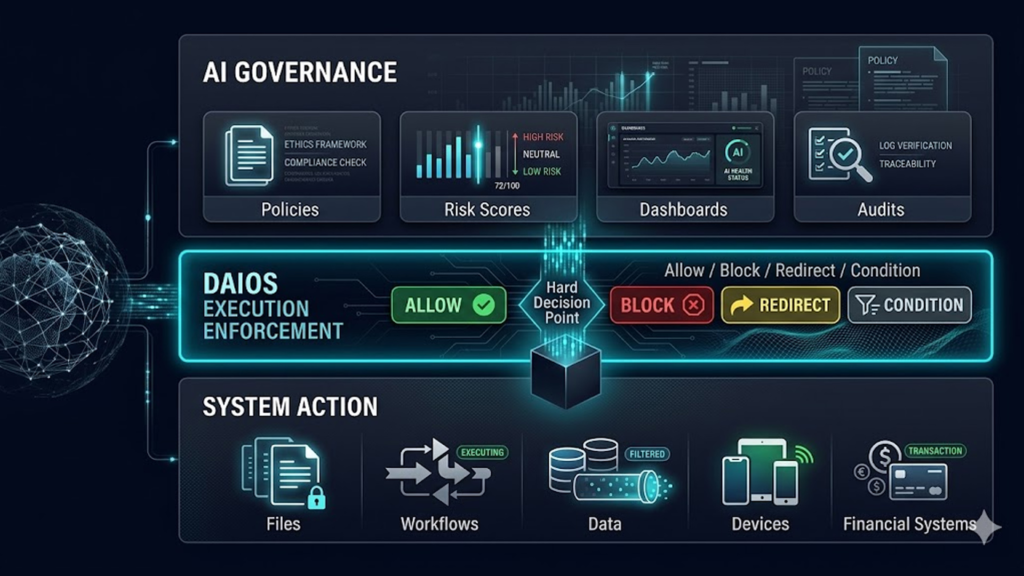
How DAIOS Moves the Boundary to Execution Enforcement
Traditional AI governance generally surrounds the system. It defines policies, monitors activity, evaluates risk, documents outcomes, and supports institutional oversight. These functions are necessary, particularly as autonomous systems become connected to enterprise data, workflows, software tools, and decision pipelines.
The limitation is that governance does not necessarily control execution.
A governance framework can define what should happen. An audit tool can record what happened. A risk model can score whether an event appears acceptable. An observability layer can detect whether behavior moved outside expected boundaries.
DAIOS moves the control point lower in the stack.
Developed by IAMMOGO, DAIOS evaluates proposed state transitions before execution proceeds. A state transition may include a model response, a file action, a system command, a routing decision, a data movement event, a user action, or any operational change that alters the system environment.
The enforcement flow can be understood as follows:
Proposed state transition
↓
DAIOS enforcement boundary
↓
Deterministic admissibility check
↓
Allow, block, redirect, condition, or request more data
↓
Execution only if authorized or required conditions are satisfied
 ↓
Audit record generated
This is a key point in the reclassification.
Execution Enforcement is not simply a hard block. If a proposed action lacks required context, supporting evidence, approval, or authority, DAIOS can condition the transition rather than automatically fail it. The system can request more data, route the action for review, require authorization, or hold execution until the missing requirement is satisfied.
That makes DAIOS an enforcement boundary rather than a monitoring layer.
It determines whether a proposed operation is allowed, denied, redirected, delayed, conditioned, escalated, or returned for additional information before the system acts.
What Execution Enforcement Does For IAMMOGO’s Public Positioning of DAIOS
The reclassification gives DAIOS a more precise public and market identity.
Under the AI governance label, DAIOS risks being compared to tools that monitor models, produce dashboards, document compliance posture, score outputs, or report risk after an event occurs. Those tools may be important, but they operate at a different layer.
Execution Enforcement places DAIOS at the point of action.
This matters because enterprise AI is becoming more operational. Systems that once generated text are now being connected to documents, internal workflows, customer records, enterprise software, financial processes, local devices, browsers, autonomous agents, automation tools, and decision pipelines.
As that shift continues, the central enterprise question changes.
The issue is no longer limited to whether an AI output can be reviewed after it appears. The more consequential question is whether the system had authority to act before the action occurred.
DAIOS is being positioned around that question.
The technology can support governance, produce evidence for governance, and strengthen institutional oversight. It should not be defined as governance itself.
IAMMOGO is now positioning DAIOS as Execution Enforcement infrastructure for autonomous systems.
Governance Defines Policy. DAIOS Enforces Execution
The reclassification of DAIOS reflects a broader issue in the enterprise AI market: policy, assessment, evidence, and enforcement are often discussed as if they belong to the same technical category, when each performs a different function.
AI governance remains necessary because organizations still need policies, oversight processes, risk frameworks, compliance documentation, legal review, liability structures, and operational standards. Those functions define how AI systems should be designed, deployed, reviewed, and governed. They establish the institutional rulebook for responsible AI use.
DAIOS operates at a different point in the stack. Rather than defining the policy environment around an AI system, DAIOS is designed to evaluate whether a proposed action is permitted to execute before that action becomes an operational event. That evaluation may result in authorization, denial, redirection, a request for more information, or a conditional hold until required approvals or supporting data are provided.
This is why IAMMOGO is formally reclassifying DAIOS from AI governance to Execution Enforcement. The distinction is structural: governance defines the rules, assessment determines whether an organization is prepared to manage those rules, evidence records what occurred, and Execution Enforcement controls whether action is allowed to occur.
As AI systems move from content generation into operational environments, that boundary becomes more important. Autonomous systems are increasingly being connected to files, workflows, software tools, financial processes, customer data, and connected devices. In that context, the central question is not only whether behavior can be reviewed after the fact, but whether the system had authority to act before the action occurred.
DAIOS belongs at that boundary because governance defines policy, but
DAIOS enforces execution.

TL;DR
IAMMOGO is reclassifying DAIOS from AI governance to Execution Enforcement to clarify that it operates at the execution boundary, not the policy or reporting layer. Governance defines and reviews the rules, while DAIOS evaluates proposed state transitions before they become operational events and determines whether they may proceed, require more information, be redirected, or be blocked.
#IAMMOGO #DAIOS #DECTL #DeterminsiticAI #ExecutionEnforcement
Disclaimer
This article reflects the views and technical perspective of Timothy Gough, Founder of IAMMOGO. References to IAMMOGO, DAIOS, Deterministic AI Infrastructure, SYNKTRON, MOGO Vault, and related systems describe proprietary concepts, technologies, and development directions associated with IAMMOGO.
Nothing in this article should be interpreted as financial, legal, cybersecurity, compliance, or investment advice. Technical descriptions are provided for informational and editorial purposes only and may include forward-looking statements, product concepts, development goals, or architectural positions that are subject to change.
Any comparisons to cloud computing, artificial intelligence systems, middleware, or enterprise technology models are intended as general industry commentary. Specific implementation details, performance outcomes, compliance results, and security capabilities may vary based on deployment environment, configuration, hardware, and operational use.
All trademarks, product names, and company names referenced belong to their respective owners. IAMMOGO is not affiliated with any third-party platform or provider unless expressly stated.