




- Philosophies
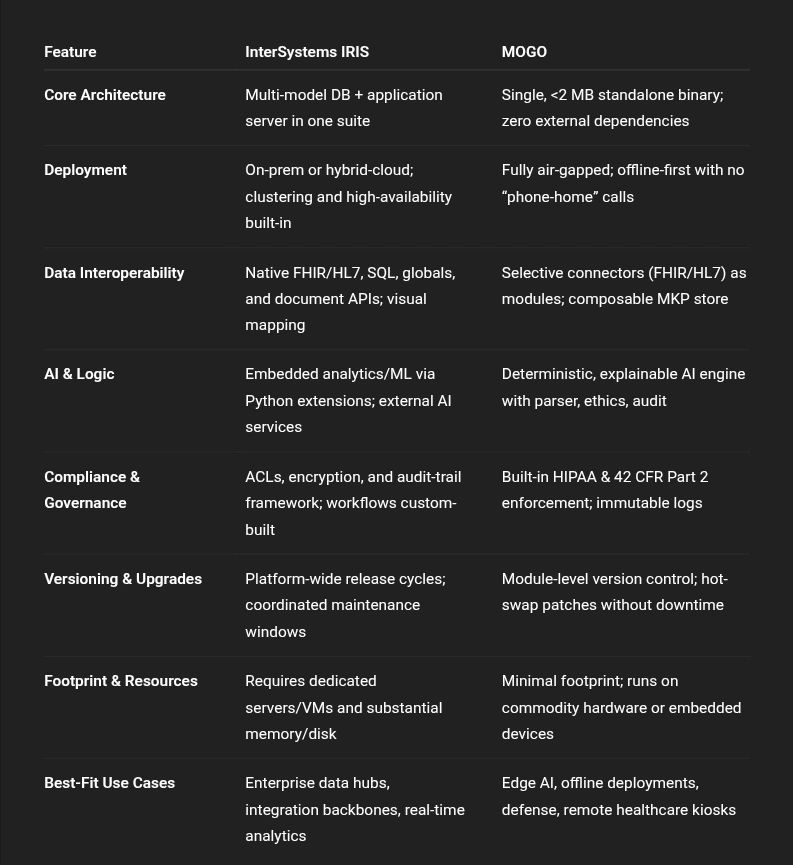
IRIS vs. MOGO
Two Very Different Philosophies of Intelligence
Technology is never just about features. It’s about philosophy.
On one side, InterSystems IRIS: an enterprise-grade backbone designed for clusters, clouds, and large organizations with deep IT infrastructure.
On the other, MOGO: a sovereign, air-gapped intelligence that runs fully offline, self-contained, ethical, and explainable in real time.
Both have strengths. But their philosophies could not be more different.
IRIS Needs the Cloud
InterSystems IRIS is designed as a multi-model database and application server bundled into one suite. It is built to live inside the world of infrastructure — hospitals, banks, and government systems where clustering, redundancy, and constant availability are the foundation. Its architecture assumes the presence of hybrid cloud deployments, virtual machines, and high-availability networks.
This makes IRIS a natural choice for organizations that already operate at massive scale. It can integrate sprawling data hubs, power backbone analytics, and connect diverse health and financial networks. But this strength also defines its character: IRIS is heavy machinery. It thrives where the grid is already strong, where the cloud is always available, and where centralization is expected.
MOGO Needs a Heartbeat
MOGO takes the opposite path. Instead of an all-in-one suite that demands infrastructure, MOGO is a standalone binary under 2 MB in size — no external dependencies, no reliance on remote servers. It is fully air-gapped, built to run offline, and engineered to never send a “phone-home” call.
This makes MOGO uniquely suited for environments where the cloud cannot go. Remote battlefields, disconnected medical stations, sovereign kiosks, or any place where security, compliance, and determinism matter more than scale. Where IRIS demands an ecosystem, MOGO requires nothing more than power and a processor.
And the difference goes deeper than deployment. MOGO doesn’t simulate intelligence through probabilistic models. It builds it deterministically. Every action is explainable, every process auditable, every output governed by ethics and compliance filters hardwired into its core. In practice, this means MOGO is not only fast and sovereign — it is transparent in ways traditional black-box AI systems can never be.
Two Philosophies, Two Futures
IRIS and MOGO do not compete for the same ground. IRIS belongs in centralized institutions with the resources to sustain complex backbones. MOGO belongs at the edge, in environments where independence, sovereignty, and ethics are non-negotiable.
Both represent strength. But only one can operate with nothing more than a heartbeat.

Deterministic AI Infrastructure: The End of Cloud Dependency
Back to all news Deterministic AI Infrastructure: The End of Cloud Dependency For more than a decade, the technology industry has moved steadily toward a

The Future of Real-Time Sync: Why Deterministic State Distribution is Disrupting Edge Computing
Back to all news The Future of Real-Time Sync: Why Deterministic State Distribution is Disrupting Edge Computing Modern real-time systems are fast, but they are

TrueState: The Binary Governance Layer AI Is Missing
Back to all news TrueState: The Binary Governance Layer AI Is Missing The central limitation of modern AI systems is not intelligence, but control. Current
TrueState Evaluation: Deterministic Enforcement in Practice
Back to all news TrueState: The Evidence of Deterministic Authority. The effectiveness of a governance system is not defined by its design, but by its

Deterministic AI Governance: Establishing Tier-1 Standards with DAIOS Infrastructure
Back to all news AI Governance Infrastructure: Independent ARAF Evaluation Identifies DAIOS as Tier-1 Evidence Infrastructure This article examines the independent evaluation of IAMMOGO’s DAIOS

Pentagon vs. Anthropic: The High-Stakes Battle for AI Oversight and Ethics
Back to all news Pentagon vs. Anthropic: The High-Stakes Battle for AI Oversight and Ethics The escalating standoff between Pentagon vs. Anthropic AI oversight has

Deterministic Web Browsing: Stop Remembering Where You Went. Start Proving What Changed.
Back to all news Deterministic Web Browsing: Stop Remembering Where You Went. Start Proving What Changed Web browsers have traditionally been designed around navigation history.

Binary Governance: Not a Gatekeeper, the Bridge Forward
Back to all news Binary Governance: Not a Gatekeeper, the Bridge Forward Speed is not truth, and fluency is not authority. Yet much of the

AI Governance Is Meta-Talk. Binary Governance Is Control.
Back to all news AI Governance Is Meta-Talk. Binary Governance Is Control. For the last few years, AI governance has become one of the most